

Quick Answer
For front teeth, flexible partial dentures (Valplast) and precision attachment partials offer the best aesthetics with no visible metal clasps. These options provide natural-looking results while maintaining comfort and functionality for your most visible teeth.
Key Points:
- Flexible partials use tooth-colored clasps that blend invisibly with gums
- Precision attachments hide metal connections inside crowns on adjacent teeth
- Traditional metal clasps should be avoided for front teeth due to visibility
When missing one or more front teeth, your primary concern is often aesthetics. The teeth at the front of your mouth (incisors and canines) define your smile, impact your speech, and shape your confidence. While partial dentures are an excellent, often more affordable, solution for filling these gaps, not all types are created equal—especially when visibility is a factor.
Your search for the best partial dentures for front teeth must balance several critical factors: natural appearance, comfortable fit, durability, and cost. You need a prosthetic that seamlessly blends with your natural teeth and gums, avoiding visible metal clasps or an overly bulky design.
This guide will explore the top considerations and most aesthetically pleasing options available, from flexible acrylic partials to metal-frame designs that utilize hidden clasps. Understanding the materials and design choices will empower you to have an informed conversation with your dentist and ultimately restore your confident, natural-looking smile.
Note: For Fast Premium Amazon Delivery: Sign up for Amazon Prime . And if you are a college/university student Sign up here.
1. Flexible Partial Dentures (e.g., Valplast)
Flexible partials are often considered the top choice for front teeth due to their superior aesthetics and comfort.


- How They Work: They are made from a lightweight, thermoplastic material (often a form of nylon) that is flexible and translucent. Instead of using metal clasps, they have gum-colored clasps that grip the natural teeth.
- Pros:
- Excellent Aesthetics: The flexible material blends in with your natural gum tissue, and because there are no visible metal clasps, they are nearly invisible. This is a major advantage for front teeth.
- Superior Comfort: They are lightweight and adapt to the natural movements of your mouth, making them very comfortable to wear.
- Non-Invasive: They do not require any drilling or preparation of the adjacent teeth.
- Durable: The flexible material is resistant to breakage, making them a long-lasting option.
- Cons:
- More Expensive: They are typically more expensive than traditional acrylic partials.
- Relining is Difficult: They can be challenging to repair or reline if your mouth changes over time.
- Special Cleaning: They require a specific, non-abrasive cleaner to avoid damage.
2. Metal-Based (Cobalt Chrome) Partial Dentures

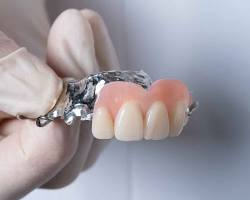
For a strong and long-lasting solution, a partial denture with a metal framework is an excellent choice.
- How They Work: These dentures have a rigid, thin metal base that supports the false teeth. The metal framework provides a strong, stable foundation, and clasps are used to anchor it to your natural teeth.
- Pros:
- Highly Stable and Secure: The metal framework and clasps provide a very secure fit, which is great for chewing and speaking.
- Durable: They are very strong and can last for many years.
- Less Bulky: The metal framework can be made much thinner than an acrylic base, making it less bulky and more comfortable.
- Cons:
- Aesthetics: The visible metal clasps can be a concern for front teeth, especially if you have a high smile line.
- More Expensive: They are more expensive than acrylic dentures.
3. Acrylic (Plastic) Partial Dentures

This is the most traditional and budget-friendly option.
- How They Work: These dentures are made entirely of a pink acrylic plastic base that holds the replacement teeth. They often use metal clasps to hold onto the adjacent teeth.
- Pros:
- Affordable: They are the least expensive option for partial dentures.
- Quick to Fabricate: They can often be made and adjusted relatively quickly.
- Easy to Add Teeth: If you lose more teeth in the future, it is often possible to add them to an acrylic denture.
- Cons:
- Aesthetics: The base is thicker and may look less natural than a flexible or metal partial. Metal clasps can be visible.
- Less Comfortable: They are bulkier and can take longer to get used to.
- Less Stable: They are not as stable as the other options.
Conclusion
For replacing missing front teeth, flexible partial dentures are generally the top choice due to their superior aesthetics and comfort. Their ability to blend in with your natural gums without visible metal clasps makes them a perfect cosmetic solution.
If your priority is a highly stable and long-lasting denture and you are not concerned about the potential for visible metal, a metal-based partial is an excellent alternative.
Always consult with a dentist or prosthodontist. They can evaluate your oral health, discuss your budget, and help you choose the best type of partial denture to restore your smile.


Partial Dentures for Front Teeth – Buying Guide
Partial dentures used to replace missing front teeth are one of the most common and aesthetically demanding dental appliances. Since the front teeth (incisors and canines) are crucial for your smile and speech, the design of the partial denture focuses heavily on natural appearance and comfort.
Here is a breakdown of the key considerations and popular types of partial dentures for the anterior (front) area of the mouth.
🎨 Key Challenges and Aesthetic Focus
Replacing front teeth with a partial denture requires overcoming several aesthetic challenges:
- Visibility: The appliance is easily seen when you smile or speak, so the denture teeth must closely match your natural teeth in color, shape, and size.
- Retention/Clasps: Traditional partials use metal clasps to hold them in place. For the front, these metal components must be hidden or eliminated to maintain a natural look.
- Gum Line: The pink base material must seamlessly blend with your natural gum tissue to avoid an obvious transition line.
- Speech: Front teeth are essential for making certain sounds, so the thickness and contour of the denture must allow for clear speech.
💡 Popular Types of Partial Dentures for Front Teeth
The materials and design chosen for a front tooth partial denture are heavily influenced by the need for aesthetics and the number of missing teeth.
1. The Flipper (Acrylic Partial Denture)
- Description: This is the most basic and affordable removable partial denture. It consists of one or more prosthetic teeth attached to a pink acrylic base.
- Aesthetics: For front teeth, it is often designed to have minimal bulk. It uses clasps that wrap around existing teeth, which are typically made of wire. Because the clasps can sometimes be visible, it is often considered a temporary or transitional solution.
- Use: Often used as an “immediate denture”—placed immediately after a tooth extraction—to restore the smile while the gum heals, or while a more permanent option (like an implant or bridge) is being planned.
- Pros: Low cost, quick to fabricate, and easy to adjust or add new teeth to.
- Cons: Bulkier than other options, less stable, and metal clasps can be visible.
2. Flexible Partial Dentures (e.g., Valplast)
- Description: These are made from a thin, thermoplastic material (like nylon) instead of rigid acrylic.
- Aesthetics: This is a popular choice for front teeth because the material is translucent and the retention mechanisms are made of the same gum-colored material, eliminating visible metal clasps. They blend very well with the natural tissues.
- Use: A good long-term solution, especially for a single missing tooth or a small number of teeth, where a high level of aesthetics is critical.
- Pros: Highly aesthetic (metal-free), lightweight, and comfortable due to its flexibility.
- Cons: Can be difficult to repair or adjust, and the flexibility may make it feel less stable than a rigid frame partial.
3. Cast Metal Framework Partial Dentures (Cobalt-Chrome)
- Description: These have a custom-designed, thin, and strong metal framework that rests on the remaining teeth and gums. Acrylic teeth are then attached to this frame.
- Aesthetics: While the framework is metal, the design for front teeth will hide the metal clasps on the back side of the adjacent teeth (or use precision attachments that fit into crowns). This allows the appliance to be much thinner and stronger than an acrylic partial.
- Use: Considered a premium, long-lasting partial denture that offers superior stability and retention.
- Pros: Extremely durable, very stable during chewing, and minimal bulk allows for better comfort and easier speech adaptation.
- Cons: Higher cost, requires more steps to fabricate, and if clasps are used, they can sometimes be seen.
🩺 Alternatives to Partial Dentures
While partial dentures are a cost-effective and non-invasive solution, especially for front teeth, many patients also consider fixed alternatives:
- Dental Bridge: A fixed restoration that replaces the missing tooth/teeth by crowning the adjacent natural teeth, using them as anchors. The most popular type for the front is the Maryland Bridge, which uses small metal or composite wings bonded to the back of the neighboring teeth, avoiding the need to fully crown healthy teeth.
- Dental Implant: The most permanent and durable option. A titanium post is surgically placed into the jawbone, and a crown is attached to it. This option prevents bone loss and looks and functions most like a natural tooth.
Your dentist or prosthodontist will determine the best partial denture type or alternative based on your oral health, budget, and aesthetic goals.
Here is a cost comparison and detailed breakdown of the options for replacing one or a few missing front teeth, ranging from the most affordable to the most permanent investment.
💰 Cost Comparison for Front Tooth Replacement
| Option | Type |
| 1. Acrylic Partial (Flipper) | Removable Aesthetics: Fair (Can look bulky, clasps may show) Upfront Cost (Initial Investment): Lowest ($300 – 1,000) Long-Term Value:Low (Often temporary; requires replacement) |
| 2. Flexible Partial (e.g., Valplast) | Removable Aesthetics: Very Good (No visible metal; gum-colored) Upfront Cost (Initial Investment): Low-to-Moderate ($800 – 1,500) Long-Term Value: Medium (Durable, but may need adjustment/replacement) |
| 3. Maryland Bridge (Resin-Bonded) | Fixed Aesthetics: Excellent (No need to crown healthy teeth) Upfront Cost (Initial Investment): Moderate ($750 – 2,000 per tooth) Long-Term Value: Medium (Least invasive; lifespan is 5-15 years, requires replacement) |
| 4. Dental Implant + Crown | Fixed (Permanent) Aesthetics: Best (Looks and feels like a natural tooth) Upfront Cost (Initial Investment): Highest ($2,000 – 4,500+ per tooth) Long-Term Value: Highest (Longest lifespan; prevents jawbone loss) |
Note: Costs are general estimates and can vary widely based on location, complexity, material (e.g., Zirconia vs. standard porcelain), and the dental practice.
⚖️ Detailed Analysis of The Most Aesthetic Options
For front teeth, the decision usually boils down to the flexible partial, the Maryland bridge, or the dental implant, as they offer the best cosmetic results.
1. Flexible Partial Denture (The Removable Aesthetic Choice)
- Initial Cost Advantage: This is the most cost-effective solution for a highly aesthetic, metal-free result.
- Aesthetics Focus: Since the front teeth are visible, the major selling point is the lack of visible metal clasps. The flexible, translucent pink base material is designed to blend in with your natural gum tissue.
- Key Compromise: It is removable. While comfortable, it will never feel as secure as a fixed tooth, and it needs to be taken out daily for cleaning. It does not prevent the jawbone from deteriorating where the tooth is missing.
2. Maryland Bridge (The Non-Invasive Fixed Choice)
- Front Tooth Ideal: The Maryland bridge is specifically well-suited for a single missing front tooth because it is minimally invasive to the adjacent healthy teeth.
- How it Works: Instead of grinding down the neighboring teeth to place full crowns (like a traditional bridge), the Maryland bridge uses a prosthetic tooth that is bonded via small wings to the back surface of the adjacent teeth.
- Key Compromise: While non-invasive, the long-term bond strength can sometimes be an issue. They can occasionally de-bond or loosen, requiring a visit to the dentist for re-cementation. Their lifespan is often shorter than an implant.
3. Single Dental Implant (The Gold Standard Investment)
- Best Long-Term Value: While the most expensive upfront, an implant can last for decades, often for life, making the long-term cost per year lower than the recurring costs of replacing bridges or partials.
- Bone Health: This is the only option that stimulates the jawbone, preventing the bone loss and gum recession that naturally occur when a tooth root is gone. This is critical for maintaining the natural contour of your lip and smile over time.
- Aesthetics Focus: It stands alone, just like a natural tooth. The crown is custom-designed for a perfect match, and it requires no support from the surrounding teeth.
🎯 Summary of Decision Factors
| Choose Partial Dentures if… | Choose Fixed Options if… |
| Your main priority is the lowest initial cost and a quick fix. | You are able to make a larger long-term investment in health and durability. |
| You need a temporary or transitional solution. | You want a permanent solution that could last 15+ years. |
| Your neighboring teeth are completely healthy and you don’t want any modifications. | The neighboring teeth are already heavily filled or need crowns (choose a Traditional Bridge). Or, if they are healthy and you want zero impact (choose an Implant). |
| You are comfortable with a removable appliance. | You want to bite and chew with maximum security. |
I recommend consulting with your dentist to review your specific X-rays and oral health needs. They can provide a personalized treatment plan and exact cost estimates.
How to Choose the Best Partial Dentures for Front Teeth
When choosing a partial denture for your front teeth, you need to prioritize the options that minimize visible clasps and offer the most natural-looking gum and tooth color.
Here is a guide on how to choose the best partial denture type for your anterior (front) teeth.
🧐 Choosing by Partial Denture Material
The biggest factor in selecting a partial for your front teeth is the material, which determines the aesthetics, comfort, and cost.
1. Flexible Partial Dentures (The Most Aesthetic Removable Option)
This is often the top recommendation for an aesthetic partial denture, especially for front teeth, due to its inconspicuous design.
- Materials: Valplast, Duraflex, TCS (all are thermoplastic, metal-free resins).
- Aesthetic Advantage:
- No Metal Clasps: The clasps are made of the same translucent, gum-colored material as the base, making them nearly invisible.
- Blends Naturally: The flexible base material is thin and blends better with the natural gum line than traditional pink acrylic.
- Key Consideration: The initial fit is excellent, but they can be more difficult to adjust or repair later compared to acrylic. They are also flexible, which provides comfort but less rigidity than a metal frame.
2. Cast Metal Partial Dentures (The Most Stable Removable Option)
While usually considered less aesthetic, this option offers superior strength and long-term stability.
- Materials: Cobalt-chrome or Titanium alloy frame with acrylic teeth.
- Aesthetic Challenge:
- Clasps: Traditional designs use metal clasps, which are visible when you smile widely.
- Solution: For the front of the mouth, your dentist may be able to design the frame with precision attachments or clasps placed on the back-side of the teeth, or use tooth-colored clasps (like Acetal Resin) for better camouflage. This, however, increases the cost.
- Key Consideration: They are less bulky and more rigid, offering better chewing function and longevity than flexible or acrylic partials. They are the “standard of care” for long-term use.
3. Acrylic Partial Dentures (The Economy/Temporary Option)
Often referred to as a “flipper” when replacing a single front tooth.
- Materials: Thick pink acrylic base with wire or metal clasps.
- Aesthetic Challenge:
- Bulky: The base is thicker than the other two types, which can feel less comfortable and look less natural.
- Visible Wires: The wire clasps used to hold it in place are usually very visible, especially on front teeth.
- Key Consideration: These are the least expensive and best suited for immediate replacement (worn right after extraction while gums heal) or a temporary solution. They are not recommended for long-term use due to poor stability and comfort.
🔑 Critical Selection Factors for Front Teeth
Beyond the material type, there are a few key aesthetic factors you must discuss with your dentist:
| Factor | What to Discuss with Your Dentist |
| Tooth Shade and Mold | Insist on a custom shade selection to match your existing teeth perfectly. Why it Matters for Front Teeth: A slight mismatch in color or size (mold) is immediately obvious on an anterior tooth. |
| Gum Shade | Request a shade of acrylic or flexible material that matches your natural gum tissue. Why it Matters for Front Teeth:In the front, the gum line is highly visible. A generic pink color can look artificial. |
| Clasp Placement | Specifically ask about placing any retentive components (clasps) on the back side of your natural teeth. Why it Matters for Front Teeth: The presence of visible metal in the front of your mouth is the #1 cosmetic complaint with partial dentures. |
| Retention vs. Bulk | Discuss finding a balance between stability and bulkiness, especially for upper front teeth. Why it Matters for Front Teeth: Too much retention (stability) can make the appliance bulky, while too little retention can cause it to feel loose or pop out while speaking or laughing. |
💡 Pro Tip: The Try-In Appointment
For the most natural-looking result, the most important visit is the wax try-in appointment.
At this appointment, you will try in the partial denture with the teeth set in wax, before the final acrylic is processed. This is your chance to:
- Approve the Size and Shape: Ensure the artificial teeth look exactly like natural teeth.
- Approve the Placement: Check that the teeth sit correctly in your smile line.
- Check the Fit: Make sure the bite feels right and the appliance is stable.
Do not be shy about requesting changes during this try-in stage; once it’s set in the final material, adjustments are much harder!
Why Online/DIY Partial Dentures are Risky for Front Teeth
The primary problem with mail-order or DIY partials is the lack of professional involvement in the crucial steps of fitting and design.
1. Severe Fit and Stability Issues
- The Problem: Online partials rely on a self-taken impression (using a kit), which is extremely difficult to do accurately.
- The Risk: Without precise measurements and professional adjustments, the denture will not fit securely. For a front tooth, this means it could be loose, move when you speak or eat, or even fall out—a major aesthetic failure.
2. Irreversible Damage to Remaining Teeth
- The Problem: A poorly designed partial denture will place excessive or unnatural force on your remaining natural teeth.
- The Risk: This force can cause your anchor teeth to shift, become loose, or accelerate bone loss around them, leading to premature loss of those healthy teeth. Dentists design the partial to distribute forces correctly.
3. Poor Aesthetics and Natural Look
- The Problem: The most critical step for front teeth is selecting the correct shade, size, and alignment to match your existing smile. Online vendors rely on generic molds and basic shades.
- The Risk: The replacement tooth will often look too bulky, be the wrong color, or be misaligned, making the replacement obvious. You lose the aesthetic advantage of having a professional match the teeth to your face and smile line.
4. Gum and Jawbone Damage
- The Problem: An ill-fitting base constantly rubs against the gum tissue and underlying jawbone.
- The Risk: This leads to chronic sore spots, inflammation, infection, and accelerated jawbone atrophy (shrinkage) in the missing tooth area. This irreversible bone loss can complicate future, better treatments (like implants).
✅ The Professional Difference: Why a Dentist is Essential
A licensed dentist or prosthodontist provides critical steps that cannot be replicated with a mail-order kit:
| Professional Step | Why It Matters for Your Front Teeth |
| Comprehensive Oral Exam | They ensure your gums and remaining teeth are healthy enough to support the partial. They check for decay, gum disease, and proper alignment before creating the appliance. |
| Precision Impression | A dental professional uses high-quality materials and techniques to capture an exact replica of your mouth, which is essential for a stable, comfortable fit. |
| Aesthetic Design and Try-In | They work with a lab to select a tooth shade and mold that complements your features. The wax try-in allows you to see the appliance and approve the look before it’s finalized. |
| Custom Clasp Design | They can design the partial to use hidden or tooth-colored clasps (precision attachments, flexible material), ensuring the most discreet look possible. |
| Adjustments and Aftercare | They adjust the partial until it is perfectly comfortable and stable. They also provide follow-up care to ensure the appliance is not damaging your gums or teeth over time. |
The Bottom Line: For front teeth, where the aesthetic and functional demands are highest, the initial savings from an online partial are likely to be far outweighed by the cost of necessary adjustments, repairs, or damage correction down the line.
Consider Dental bridge or Dental implant?
For replacing missing front teeth, the two gold-standard, non-removable options—which offer the best aesthetics and function—are Dental Implants and Dental Bridges.
The best choice for you will depend on your budget, the condition of your adjacent teeth, and your long-term goals for your oral health.
Here is a detailed comparison to help you understand the pros and cons of each:
🥇 Option 1: Dental Implant (The Gold Standard)
A dental implant is a titanium post surgically placed into the jawbone to replace the root of the missing tooth, with a custom-made crown placed on top.
| Pros for Front Teeth | Cons for Front Teeth |
| Aesthetics Superior. The crown emerges from the gum line, looking and feeling exactly like a natural tooth. |
Aesthetics The process takes several months (3-9 months) to allow the implant to fuse with the bone. |
| Impact on Other Teeth None. It is completely independent and does not require grinding down healthy adjacent teeth. |
Impact on Other Teeth Higher initial cost compared to a bridge. |
| Longevity The longest-lasting. Can last a lifetime with proper care, making it the most cost-effective option over the long term. |
Longevity Requires a minor surgical procedure, and you need adequate jawbone to support the implant (though bone grafting is an option if bone is lacking). |
| Bone Health Preserves the jawbone. The implant stimulates the bone, preventing the bone loss (shrinkage) that occurs after a tooth root is gone. This is vital for maintaining the natural shape of your face and gum line. |
🥈 Option 2: Dental Bridge (Fixed or Traditional)
A traditional bridge replaces the missing tooth by placing a crown on the two adjacent teeth and suspending a replacement tooth (pontic) between them.
| Pros for Front Teeth | Cons for Front Teeth |
| Aesthetics Excellent. A well-made bridge is customized to match your other teeth and is cemented permanently. |
Aesthetics Requires grinding down the healthy enamel of the two teeth adjacent to the gap, potentially compromising their long-term health. |
| Impact on Other Teeth The procedure is non-surgical and much faster, typically completed in just a few weeks. |
Impact on Other Teeth Does not preserve bone. The jawbone beneath the missing tooth can shrink over time, which can create a visible dark or sunken gap under the bridge. |
| Longevity Lower initial cost than an implant. |
Longevity Shorter lifespan, typically 10–15 years, and will need to be replaced. |
| Other Easy to clean with normal brushing (though special flossers are needed to clean under the bridge). |
Other If one of the anchor teeth develops a problem, the entire bridge may need to be replaced. |
Summary of Replacement Options
| Solution | Dental Implant | Traditional Bridge | Online/DIY Partial |
| Permanence | Fixed (Permanent) | Fixed (Permanent) | Removable (Temporary) |
| Longevity | Lifetime (usually 20+ years) | 10–15 years | Very short (Months) |
| Bone Preservation | Yes (Prevents bone loss) | No (Bone loss occurs) | No (Bone loss occurs) |
| Aesthetic Result | Most Natural (Crown emerges from gum) | Excellent (Can blend well) | Poor (Bulky, wrong color/fit) |
| Cost | Highest Initial Cost | Moderate Initial Cost | Lowest Initial Cost (But high risk of future cost) |
Key Consideration for Front Teeth:
For a single missing front tooth, the Dental Implant is generally considered the best long-term solution because it protects the healthy neighboring teeth and prevents the jawbone from shrinking, which is critical for maintaining a natural-looking smile over time.
Best selling partial dentures for front teeth:


Today’s deals:


Similar Posts:
- None Found


Dr. Tom Bell has a PhD in Medical Anthropology. He has a keen interest in oral health topics and is the founder of dentalrave. He has been an oral health researcher and electric toothbrush enthusiast for over 10 years. Tom works with Awin and others in his research. When not talking about dental hygiene and gadgets, Tom likes spending time outdoors hiking.
